
Holiday Lights Safety: How to Light Up Your Miami Home Without Tripping a Breaker
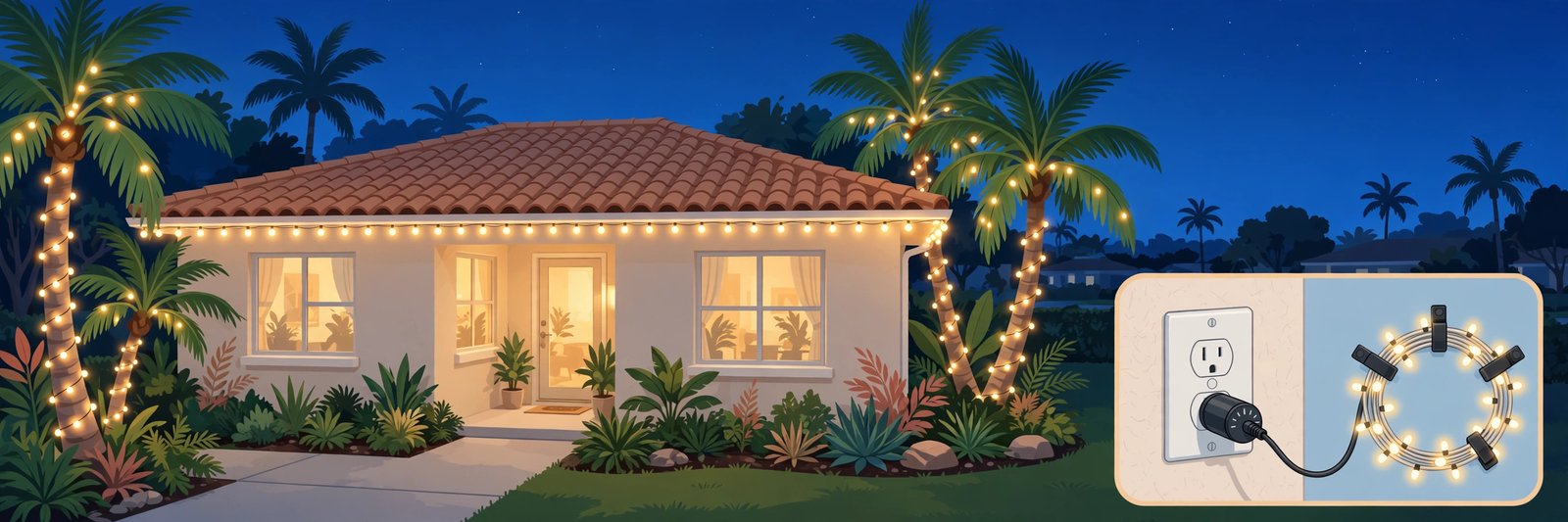
Yes — you can hang holiday lights without tripping breakers or creating a fire risk, if you do three things: use LED lights rated for outdoor use, add up the watts before you plug anything in, and power them from a GFCI-protected outdoor outlet through a timer. Most holiday-light problems come from skipping one of those three steps, not from the lights themselves. The checklist below walks through them in order, from the box to the first switch-on.
Step 1: Inspect before you hang anything
Unroll every strand on the ground first, before the ladder comes out. Look for frayed wires, cracked sockets, and bulbs that are loose in their bases — and for the damage last year's storage may have caused, like a cord crushed under a box or chewed by pests. Plug each strand in for a minute and watch for flickering sections or a plug that feels warm. A strand that fails this test goes in the trash, not back on the roof: electrical tape over a damaged cord is not a repair, and a strand that flickers on the ground will only get worse in the weather.
Step 2: Do the load math
Every light string has a wattage printed on its box or its tag. Add up the watts of everything going on one circuit, then divide by 120 to get the amps — or skip the division and use the simpler limit: a standard 15-amp household circuit should carry no more than about 1,440 watts on a sustained load. That is why LEDs matter so much here. A string of incandescent mini-lights can draw 40 watts or more, while a comparable LED string draws a small fraction of that, so a whole roofline of LEDs often pulls less power than a single old incandescent string. Whatever the bulb type, never connect more strands end to end than the number printed on the box — that limit is the manufacturer telling you where the first string's wiring stops being safe.
Step 3: Outdoors means outdoor-rated — everything
Lights, extension cords, and timers all need to be rated for outdoor use. An indoor extension cord outside will crack, absorb moisture, and fail, and in Miami it will fail fast: even in the drier December weeks, afternoon rain still shows up, and humidity and salt air corrode exposed connections all season. Keep every connection off the ground and out of puddles, and give cords a drip loop — a low sag before the connection — so rainwater runs off instead of into the plug. If a cord has to cross a walkway, run it where nobody steps on it; a cord crushed underfoot is a cord with damaged insulation.
Step 4: The outlet has to be right
Holiday lights belong on an outdoor outlet with GFCI protection and a weather-resistant, in-use cover — the kind with a lid that closes over the plug while it is in use. If the only outdoor outlet is an old unprotected one, or if there is no outdoor outlet at all and the plan is to run a cord through a window or a door, stop there: a pinched cord in a window frame is a fire risk, and an unprotected outdoor outlet is a shock risk. That is the point to call a licensed electrician for a proper outdoor outlet or a dedicated circuit — a small job that makes every future holiday season safe.
Step 5: Hang with clips, not staples
Use plastic light clips made for gutters, shingles, or eaves. Never fasten a light string with staples, nails, or screws: one staple through a wire turns a decoration into a short circuit, and the damage often hides until the lights are on and the breaker trips. Keep strings clear of gutters full of dry leaves, and keep any cord away from the grill or the fire pit.
Step 6: Put it on a timer, then flip the switch
A timer is the cheapest safety device in this whole project. Set the lights to run in the evening and switch off overnight — six hours on is plenty for a display, and it keeps the lights from running unattended while everyone sleeps. It also saves power and extends the life of the strings. Once the timer is set and every connection is off the ground, flip the switch. If the breaker trips the moment the lights come on, do not just reset it and try again: unplug half the load, check for a damaged strand or a wet connection, and reset only after the cause is found. A breaker that keeps tripping is doing its job — something is wrong.
When to call an electrician instead of pushing through
- The breaker trips more than once, or an outlet or cord feels warm.
- The lights flicker, dim, or go out in sections.
- There is no GFCI-protected outdoor outlet, or the outdoor outlet is cracked, loose, or corroded.
- You want permanent roofline lighting or a dedicated outdoor circuit so the display never shares a circuit with the rest of the house again.
Quick FAQ
Can I plug holiday lights into any outdoor outlet?
Only one with GFCI protection and a weather-resistant in-use cover. GFCI protection is what shuts the power off in a fraction of a second if current leaks — for example, through rainwater into a connection. If your outdoor outlet has no TEST and RESET buttons, it is not GFCI-protected.
How many strings can I connect end to end?
Only as many as the number printed on the box or the tag — usually three to five for LED strings, fewer for incandescent. Going past that limit overloads the wiring in the first string, even if the breaker never trips.
Should I leave holiday lights on all night?
No. Put them on a timer so they switch off overnight and while nobody is home. Lights running unattended are the ones most likely to turn a small fault into a real problem, and a timer costs less than a single replacement string.
Holiday lights should be the easiest decoration in the house, not the one that trips the breaker on the first night. Inspect the strands, add up the watts, use outdoor-rated gear on a GFCI-protected outlet, hang with clips, and let a timer do the switching off. If you would rather have it handled for you — or if your outdoor outlets need upgrading before the season starts — call Trusted Electrical Solutions at 786-342-9582 or visit www.trustedelectricalsolutions.com to schedule your free inspection and quote today.
---
Leave a comment
Tag Group
Recent Posts

About Author


Our Trusted Electrical Solutions takes great pride in delivering the best electrical services to our customers. We strive to ensure that each customer is satisfied with their experience.
If you are looking for an electrician, we encourage you to give us a call.
We look forward to helping you with all your electrical needs.

Quick Links
Business Hours
Mon - Sunday
24 Hours
Copyright © Trusted Electrical Solutions · Admin Login