
Blog

When Is the Right Time to Install Electrical Panels in Miami?
26 Jun, 2026
306
Info
Install or upgrade your electrical panel when your home's life changes — a renovation, a home purchase, repeated outages, or simply more devices than the panel was built for — or when the panel itself starts showing warning signs. A licensed electrician sizes the replacement with a proper load calculation, and the work falls under the Florida Building Code and Miami-Dade County amendments.
Life event one: the renovation
A significant renovation or addition is the natural moment to evaluate the panel. New appliances and systems need more power, and upgrading the panel while the work is already happening is cheaper and simpler than doing it as a separate job later. If the renovation adds load, the panel question comes first, not last.
Life event two: buying an older home
If you are purchasing an older home, have the electrical panel inspected as part of the home inspection. A fuse box or an old circuit breaker panel may not keep up with modern appliances, and finding that out before you buy is far cheaper than finding it out after the first tripped breaker. This check prevents headaches and unexpected expenses that no buyer wants in the first month.
Life event three: the outages keep coming
Frequent power outages can signal that the panel is not functioning correctly. In a humid climate, salt-air corrosion accelerates wear on electrical systems, and an aging panel in that environment fails sooner than the same panel would inland. Outages that keep returning are a symptom, not a coincidence — have the panel checked.
Life event four: the load outgrew the panel
Lifestyles change: a home office, an entertainment system, more electronics in every room. The panel that served the house twenty years ago was sized for a different life. If your home's energy use has grown and the panel has not, an upgrade is a matter of when, not if.
Warning signs the panel is telling you now
Circuit breakers that trip often mean an overloaded panel or one that cannot handle the home's load. Flickering or dimming lights can point to the panel or the wiring connected to it. A burning smell or discoloration around the panel is serious — call a professional immediately. And if the home still has a fuse box, that alone is a reason to talk to an electrician about an upgrade.
DIY vs. professional installation
Electrical panel work is complex and dangerous when handled wrong, and it must comply with local codes. Hiring a licensed electrician ensures safety and compliance, from the assessment through the installation. The utility's service rules govern the connection itself, but the panel and the wiring are code work — and code work belongs to a licensed electrician.
Quick FAQ
How do I know what size panel my home needs?
A load calculation decides it: the electrician adds up everything the home runs and sizes the panel to that total, with room to grow. Guessing the size is how panels end up undersized twice.
Will a new panel lower my electric bill?
Not directly. A new panel makes the system safer and able to carry the load; savings come from the efficient appliances it can now support, not from the panel itself.
How long does a panel replacement take?
Usually a day for the swap itself, with power off for part of it. The permit and inspection schedule around it, so plan the timing with your electrician.
Call Trusted Electrical Solutions at 786-342-9582 or visit www.trustedelectricalsolutions.com to schedule a panel inspection.
---
 Jose Luis Rey
Is It Time to Upgrade Your Smoke Detectors in Miami?
25 Jun, 2026
326
Info
Your smoke detector tells you when it is done — chirping with a fresh battery, false alarms with no fire, visible damage, or a manufacture date more than ten years old. Any one of those means replace it. A detector past ten years is not protecting you, even if it still beeps when you press the test button, because the sensing element itself degrades with age.
What the chirp means
A detector that beeps at intervals is usually asking for a battery, so change it first. If the chirping continues with a fresh battery, the unit itself is nearing the end of its life — the battery was never the problem. Do not put this off: a chirping detector is a detector telling you it cannot be trusted.
What the false alarms mean
A detector that goes off frequently without a fire may be malfunctioning, especially if it is older. Humidity can make false alarms more common, and dust or a placement too close to a kitchen or bathroom can do the same. Move the unit first if placement is the problem; if the alarms continue in a good spot, the unit is the problem.
What the date stamp says
Smoke detectors typically last about ten years. The manufacture date is stamped on the back of the unit — check it. Past a decade, the sensing element has degraded whether the test button still sounds or not, and replacement is the only fix. Miami's humidity and salt air push toward the shorter end of that range, not the longer one.
What the damage shows
Cracks, dirt buildup, or corrosion on the unit mean replacement. Damage can stop a detector from working when it matters, and in a humid coastal climate corrosion is not cosmetic — it is the device wearing out from the outside in. A damaged detector is a decoration, not protection.
What the code changes mean
Local building codes change over time, and a detector that met the rules when it was installed may not meet them now — especially after a renovation or a move into a new home. Check that your detectors comply with the Florida Building Code and Miami-Dade County amendments as they stand today. The utility does not set detector rules; codes come from the building code, and that is the standard to check against.
Choosing the replacement
Ionization detectors are best for fast-flaming fires, photoelectric for slow-burning ones, and dual-sensor units combine both for comprehensive coverage. Smart detectors can send alerts to your phone, so you can monitor the home even when you are away. Place them on every level, especially near bedrooms, and keep them interconnected so one alarm sounds them all.
Keeping the new ones alive
Test monthly by pressing the test button. Change batteries twice a year — a good rule is to do it when you change your clocks for Daylight Saving Time. Vacuum the units gently to keep dust and debris from hindering performance.
Quick FAQ
Why does my detector chirp in the middle of the night?
Almost always a low battery, or a unit near the end of its life. Replace the battery first; if the chirping continues, replace the unit.
Do smart detectors still sound without Wi-Fi?
Yes. The alarm itself works without a connection — the phone alert is the extra feature, not the protection. The siren is local and always on.
How do I find the manufacture date?
It is printed on the back of the unit. Remove it from its mount, read the date, and if it is more than ten years old, replace it.
Call Trusted Electrical Solutions at 786-342-9582 or visit www.trustedelectricalsolutions.com to schedule a smoke detector upgrade check.
---
Jose Luis Rey
Prepare Your Power Strips for Hurricane Season in Miami
24 Jun, 2026
329
Info
Before a storm, inspect every power strip, replace the damaged ones, put sensitive electronics behind real surge protection, and unplug the non-essentials in a set order so the essentials stay safe. Hurricane season runs June 1 through November 30, and this whole prep takes an afternoon — do it before the forecast turns, not during it.
First to go: the damaged strips
Inspect each strip before the season opens. Frayed or damaged cords can short-circuit. Burn marks or melted plastic mean the strip has already overheated. Plugs that fit loosely are a fire risk waiting for a surge. Any strip showing one of these signs goes in the trash and gets replaced with a new, high-quality one — preferably a surge-protecting model rated for the job.
Second: the overload
Each power strip has a maximum load, and exceeding it causes overheating and fire hazards. Group electronics by power need: heavy appliances like refrigerators and air conditioners belong on separate circuits from smaller devices, not sharing a strip with them. In older homes or homes with outdated wiring, the margin is thinner, so be extra careful about what shares a strip.
Third: the outdoor gear
Outdoor electronics need weather-resistant power strips, built to withstand moisture — for patio lights, grills, and anything else that lives outside. Plug outdoor strips into GFCI outlets, which protect against electrical shock where water is a factor. An indoor strip used outdoors is not a bargain; it is a hazard.
What stays on: real surge protection
A power strip protects what is plugged into it and nothing else. A whole-home surge protector, installed at the main electrical panel, covers the entire system at once — including the hardwired appliances no strip can reach. Use strips as the second layer for sensitive electronics, never as the only defense, and have the panel-side work done by a licensed electrician.
The label system
Label your power sources now, while it is calm: mark which outlets feed essential appliances and which feed non-essentials. When a storm approaches, you can unplug the non-essentials in minutes and keep the home running on what matters. Pair the labels with a family emergency plan — where the flashlights and batteries are, how to open the garage door manually, and which devices are critical to keep powered.
The breaker check
Before the storm hits, check the circuit breaker: confirm it works, confirm you can reach it easily in an emergency, and make sure everyone in the house knows how to reset it if a surge trips it. A breaker you cannot find in the dark is not a safety device.
Quick FAQ
Is a surge-protector strip enough for storm season?
No, not on its own. It protects what is plugged into it. Whole-house protection at the panel plus strips at sensitive devices is the combination that covers a home.
Can I use an indoor power strip outside during a storm?
No. Outdoor strips must be weather-resistant and plugged into GFCI outlets. An indoor strip exposed to rain or flooding is a shock and fire risk.
Should I unplug everything when the storm arrives?
Unplug the non-essentials and leave the essentials on protected circuits. A whole-home surge protector plus labeled outlets makes that decision quick instead of a scramble.
Call Trusted Electrical Solutions at 786-342-9582 or visit www.trustedelectricalsolutions.com to book a pre-storm electrical check.
---
Jose Luis Rey

When Is the Right Time to Install Smoke Detectors in Miami?
23 Jun, 2026
316
Info
Install smoke detectors the day you move in, whenever a renovation changes the layout or the wiring, and after any fire incident — and replace any unit older than ten years no matter what occasion brings it up. Placement is every level of the home, outside sleeping areas, and in bedrooms in larger homes, and the Florida Fire Prevention Code requires detectors in residential buildings, so this is compliance as well as safety.
Occasion one: moving in
A new home does not mean new detectors. The previous owner may have left units that are a decade old, disconnected, or missing entirely, so one of the first jobs after moving in is to walk the house, check the manufacture date on the back of every unit, test each one, and replace anything past ten years or anything that fails the test. Do not assume the last owner kept them current.
Occasion two: renovating
Renovations disturb wiring and change floor plans, and both change where detectors belong. When walls move, placement rules move with them — detectors still go on every level, inside bedrooms, and outside sleeping areas, reassessed against the new layout rather than the old one. Dust is the other renovation hazard: cover detectors that stay in place, never paint over one, and keep units interconnected so that when one sounds, they all do.
Occasion three: after a fire
Even a small fire — in your home or a nearby one — is a reason to assess the whole detection system. Heat and smoke can damage a detector without leaving obvious marks, and a fire is the clearest possible reminder of what the devices are for. Check every unit, replace anything suspect, and use the moment to confirm the system covers the home as it stands now.
The installation itself
There are two main types: ionization detectors respond fastest to flaming fires, photoelectric detectors to smoldering fires, and a combination of both — or dual-sensor units — gives the most complete coverage. Mount detectors high on walls or ceilings, at least 4 inches from any corner, and keep them out of kitchens and bathrooms, where cooking smoke and steam cause false alarms. Test monthly with the test button, and replace batteries at least once a year.
Warning signs your detectors need attention
Frequent false alarms can mean a malfunctioning unit or one too sensitive to humidity. Chirping usually means a low battery or a unit near the end of its life. Physical damage — cracks or corrosion, a real risk near the coast where salt air wears on everything — means replacement, not cleaning. Miami's humidity already shortens a detector's easy life, so treat the ten-year mark as a deadline, not a suggestion.
Quick FAQ
How many smoke detectors does my home need?
At minimum, one on every level and one outside each sleeping area, plus one in each bedroom in larger homes. More coverage beats less.
Ionization or photoelectric — which should I buy?
Both, ideally: ionization for fast flaming fires, photoelectric for slow smoldering ones. Dual-sensor units combine them in one device.
Do I need a permit to install battery smoke detectors?
No. Battery-powered units need no permit. Hardwired detector work done as part of a permitted renovation falls under that job's permit.
Call Trusted Electrical Solutions at 786-342-9582 or visit www.trustedelectricalsolutions.com to schedule a smoke detector safety check.
---
Jose Luis Rey
Light Fixtures FAQs: Your Guide
18 Jun, 2026
339
Info
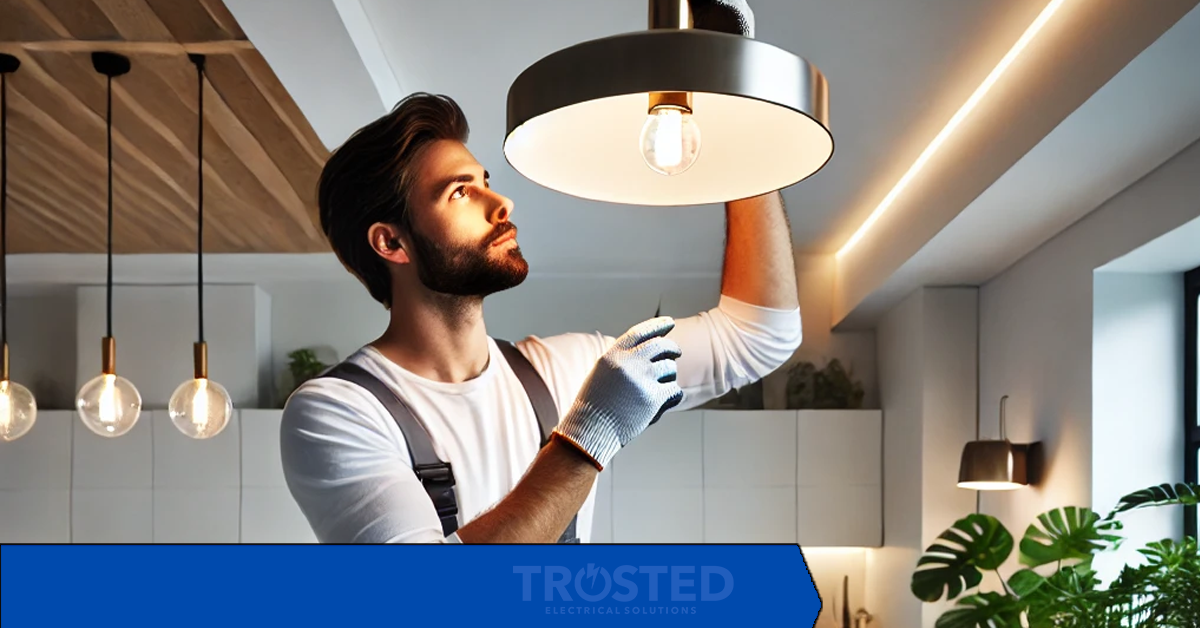
The right light fixture comes down to three things: the size of the room, the height of the ceiling, and the job the light has to do — and in Miami, humidity and salt air decide the materials. The five questions below are the ones homeowners actually ask, answered in the order they usually come up.
Question 1: which type fits the room?
Chandeliers suit dining rooms and entryways, where they can be the focal point. Recessed lighting fits modern homes and gives a sleek, unobtrusive look. Wall sconces work for hallways and accent walls, adding soft light without taking floor or ceiling space. Outdoors, the type matters less than the rating — fixtures must be built for wet locations and resistant to corrosion. Match the fixture to the room first; the style follows from that.
Question 2: which bulb should I use?
Incandescent, LED, and CFL each have their place, but LED is the default answer for most Miami homes: it is energy-efficient, lasts far longer, and holds up better in humid conditions. Color temperature is the second choice — warmer tones create a cozy atmosphere, cooler tones feel more energizing — so pick the temperature for the room's mood, not just the brightest bulb on the shelf.
Question 3: what changes outdoors?
Everything about the weather works against an outdoor fixture here. Look for lights rated for wet locations and made from corrosion-resistant materials, so humidity and salt air do not eat them within a couple of seasons. Solar lights are a solid eco-friendly option for garden and path lighting, since they need no wiring at all.
Question 4: when is a fixture failing?
Four symptoms say a fixture needs attention rather than a new bulb: flickering lights or bulbs that burn out far too often, discoloration or rust on metal parts, buzzing sounds when the light is on, and a fixture that feels hot to the touch. Any one of these is worth an inspection, and a hot fixture is worth one promptly — it can mean a wiring problem behind the fixture, not a bulb problem inside it.
Question 5: how do I make my lighting efficient?
Use LED bulbs wherever they fit, install dimmer switches so brightness matches the moment instead of running full power all evening, and consider smart lighting that lets you control lights remotely and set schedules. Efficiency here is a stack of small choices, not one big purchase.
The maintenance round
Dust and dirt build up on fixtures and quietly cut brightness, so clean them regularly. Check bulbs and fixture connections whenever flickering appears, and schedule an annual inspection of your home's electrical system — especially in an older home, where wiring and fixture boxes may predate modern standards. Installation and replacement work falls under local building codes; a licensed electrician knows which jobs need a permit and which do not.
Quick FAQ
Can I put a chandelier in a room with a low ceiling?
Only if the clearance works — the bottom of the fixture should stay well above head height. In a low room, a flush mount or a short-drop fixture is the safer choice.
How often should my fixtures be inspected?
Once a year as part of a general electrical inspection, and right away if any fixture flickers, buzzes, or feels hot.
Are smart fixtures worth it?
For rooms where you want schedules, dimming, or remote control, yes. For a fixture that is simply on or off, a standard LED with a dimmer does the same job for less.
Call Trusted Electrical Solutions at 786-342-9582 or visit www.trustedelectricalsolutions.com to schedule a lighting consultation.
---
Jose Luis Rey
Tag Group
Recent Posts

About Author

Our Trusted Electrical Solutions takes great pride in delivering the best electrical services to our customers. We strive to ensure that each customer is satisfied with their experience.
If you are looking for an electrician, we encourage you to give us a call.
We look forward to helping you with all your electrical needs.

Quick Links
Business Hours
Mon - Sunday
24 Hours
Copyright © Trusted Electrical Solutions · Admin Login
Request a service