
Blog

Understanding EV Chargers: Safety Insights for Miami
09 Dec, 2025
404
Info
EV charger listings read like alphabet soup: UL, kW, GFCI, IP ratings. Here is the spec sheet, torn down line by line, with what each spec actually means for your home's safety.
Spec: UL Certification — "Has this thing been tested?"
UL certification means the charger has been independently tested for safety. If a charger lacks it, no price is low enough. This is the first line on the spec sheet and the first filter in your search.
Spec: Charging level — "How much power does it pull?"
Level 1 runs on a standard outlet and trickles. Level 2 — what most homeowners install — pulls serious current on a dedicated circuit. That is why a Level 2 install is not a plug-and-play purchase: the circuit, the breaker, and the panel all have to be sized for it. An overloaded circuit announces itself by tripping the breaker during charging — call an expert if yours does.
Spec: Ground fault protection — "What happens when something leaks?"
Ground fault protection cuts power if current leaks where it should not — the same principle as a GFCI outlet, and vital for families with children. Outdoor chargers live in rain and humidity; ground fault protection is what stands between a wet charging session and a shock.
Spec: Smart charging / Wi-Fi — "Can it think?"
Smart features let you monitor charging, set schedules, and get alerts — and scheduling prevents overuse and overload. But smart features do not replace safe wiring; they sit on top of it.
Spec: Weather rating — "Can it live outside in South Florida?"
Humidity and salt air wear electrical systems faster than dry climates do. Chargers designed for outdoor use resist rust and corrosion. If your charger lives outside, its enclosure rating is a safety spec, not a marketing one — and regular cleaning of charger ports keeps every connection safe.
Spec: Code compliance — "Is this install legal?"
Local building codes and Florida Power & Light regulations govern EV installations, and requirements vary by area. Your homeowner's association or local rules may have their own say. A licensed electrician confirms compliance before installation — an improperly installed charger is a safety risk and can void warranties.
Warning signs the spec sheet cannot fix
Tripping circuit breakers during charging. Burning smells, popping sounds, or flickering lights while charging. Visual damage: corrosion, frayed wires, anything that looks off. Any of these means stop using the charger and call a professional.
The maintenance checklist
Monthly visual inspection for wear, corrosion, or damage on charger and cords. Clean charger ports regularly for a safe connection every time. Monitor charging habits — intermittent charging lets the system cool and reduces strain.
The install itself
Professional installation matters. A licensed electrician integrates the charger with your home's existing electrical system, confirms code compliance, and diagnoses pitfalls before they become costly issues. That is the difference between a charger that works and a charger that is safe.
As you embrace electric vehicles, make the safety of your charging setup the top priority. Ready to install or inspect yours? Contact Trusted Electrical Solutions at 786-342-9582 or visit www.trustedelectricalsolutions.com to schedule a free inspection and quote.
---
 Jose Luis Rey

Top 5 Signs You Need GFCI Outlets Before Selling Your Home
08 Dec, 2025
462
Info
A buyer's inspector photographs everything. Before you list, walk your home with a camera and look at the five photos that lose sellers the most money. Every one of them is a GFCI problem.
Listing photo #1: The bathroom outlet — two prongs, no buttons
If your bathrooms still have two-prong outlets with no TEST and RESET buttons, that is the first photo in the inspection report. GFCI outlets shut off a circuit the instant they detect a ground fault — in a wet room, that is the difference between a shock and a scare. In a humid, salt-air climate, GFCI protection in bathrooms, kitchens, and outdoor areas is not a recommendation; it is a code requirement and a buyer expectation.
Listing photo #2: The kitchen outlet that trips the breaker
Are you constantly resetting breakers? Frequent tripping signals overloading or a deeper electrical problem. GFCI outlets are designed to prevent shock hazards by shutting off circuits when necessary — and a kitchen that trips its breaker every time the toaster runs tells a buyer the wiring was never brought up to modern standards.
Listing photo #3: The outdoor outlet with water stains
Rainy weather leaves pools of water around outdoor outlets and fixtures. Moisture near an outlet is a critical find: GFCI outlets detect fault currents and prevent shock in wet areas. A buyer who sees water staining around an unprotected outdoor outlet will either walk away or demand a credit.
Listing photo #4: The extension cord farm
Extension cords as a long-term solution are a major red flag. If cords are snaking across rooms to reach the outlets you actually need, buyers read it as "not enough outlets, and the ones here are not safe." More properly placed GFCI outlets eliminate the cords and the objection.
Listing photo #5: The 1980s panel schedule
If your home was built before the 1990s, GFCI outlets probably were not required when it was wired — and knowledgeable buyers know it. An older electrical system without GFCI protection in wet areas signals a home that has not kept up with safety codes, and it directly affects selling potential.
Why this upgrade pays at closing
GFCI outlets protect against shock in a climate where humidity corrodes outlet components faster than in drier regions. Choose high-quality products — cheap outlets fail sooner in humid air. The upgrade reassures buyers, satisfies code, and adds marketability. It is one of the smallest investments that shows up in an inspection report.
One maintenance habit for the new owner (and for you, until closing)
Test every GFCI monthly: press the TEST button, confirm it trips, press RESET. It takes ten seconds and proves the protection is alive.
One more thing from the old guide: how to spot a GFCI outlet
If you're unsure whether your home has GFCI outlets, look for outlets with a reset and test button on the face. You'll find them near sinks, in garages, and on outdoor patios. If you notice any areas lacking GFCI protection, it might be time to consider an upgrade — especially before listing your home.
Notice any of the five photos in your own home? Upgrading to GFCI outlets is investing in your peace of mind and your home's market appeal. Contact Trusted Electrical Solutions at 786-342-9582 or visit www.trustedelectricalsolutions.com to schedule a free inspection and quote — and get your home ready to attract buyers.
---
Jose Luis Rey

Everything Miami Homeowners Must Know About Electrical Panels
06 Dec, 2025
421
Info
Every appliance in your home has an owner's manual. Your electrical panel is the one machine that runs all of them — and it is the one manual nobody reads. Here it is.
Section 1: Specifications
Your panel is the heart of your home's electrical system. It manages your electrical supply and decides how efficiently energy flows to everything from lighting to air conditioning — critical in a climate where the AC rarely rests. Older panels typically offer 100 amps. Modern homes, with their electronics, appliances, and chargers, usually need 150 or even 200 amps. If your home is older than 20 years, there is a good chance your panel no longer meets today's demands.
Section 2: Warning lights (symptoms that mean "stop and call")
Flickering or dimming lights when other appliances run: the panel may be overloaded.
Frequent breaker trips: a problem with the panel or chronic overloading. Do not ignore it.
Buzzing sounds: a loose connection or a failing component. A buzzing panel is never a good sign.
Burning smell near the panel: pull the plug on the situation — your safety is at stake. Call immediately.
Section 3: Environmental notes (South Florida edition)
Salt air causes corrosion. If you live near the coastline, make sure your panel is installed properly and built to withstand it — corrosion on contacts and connections is one of the most common causes of panel trouble here. Humidity accelerates the same damage, and storm season adds power surges to the list.
Section 4: Upgrade checklist
Before upgrading, confirm four things: amperage (100 vs 150/200 for your actual load), branch circuits (dedicated circuits for the refrigerator, HVAC, and other heavy appliances — if you lack them, the panel layout needs restructuring), code compliance (South Florida standards must be met, and an outdated panel may not comply), and installer qualifications (below).
Section 5: Hiring the installer
Experience with local codes — they must be well-versed in regulations from FPL and Miami-Dade County. Reputation — check reviews from other homeowners in your area. Insurance and licensing — a licensed, insured electrician protects your property and your interests. In neighborhoods with heavy renovation activity, where electrical demand shifts with every remodel, that experience matters even more.
Section 6: Maintenance schedule
Inspect your panel annually for dust, moisture, or corrosion — if you are unsure what you are looking at, call a professional. Do not overload circuits, especially in older homes that were not built for modern electrical needs. Install surge protectors, ideally before storm season, to guard against power spikes.
Section 7: Troubleshooting
Lights dimming when the AC kicks on? Breaker tripping every time the microwave runs? Burning smell, buzzing, or a panel that is warm to the touch? Those are not quirks — they are the warning lights in Section 2. Do not wait for the panel to make the decision for you.
Your panel is the hardest-working equipment in your house. Treat it like it has a manual — because now it does. If yours shows any warning sign, or has not been inspected in years, contact Trusted Electrical Solutions at 786-342-9582 or visit www.trustedelectricalsolutions.com to schedule a free inspection and quote.
---
Jose Luis Rey
Is It Safe to Plug New Electronics Into Old Outlets? Miami Electrician Explains
28 Nov, 2025
596
Info
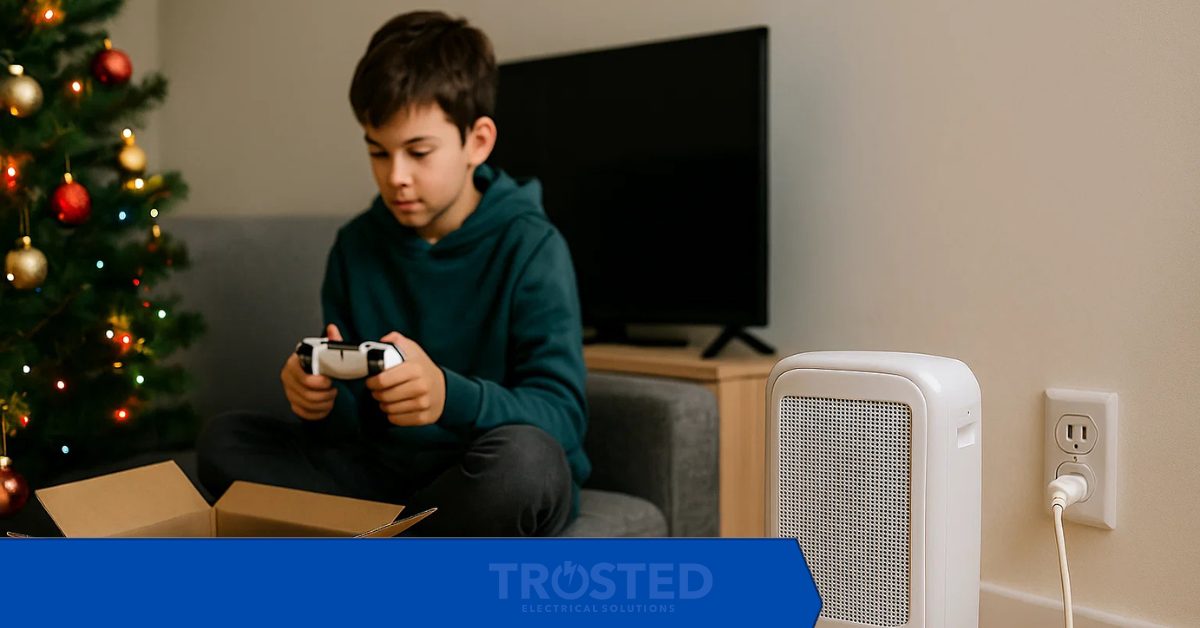
A family unboxes a new gaming console for the kids. They plug it into the same outlet already powering the holiday lights, a space heater, and the Wi-Fi. Pop. Breaker trips instantly.
The console was not the problem. The backpack was already full.
Think of every circuit like a backpack
A phone charger is a pair of socks — barely any weight. A gaming PC is a pair of bricks. A space heater is a cement block. Holiday lights, a TV, a dehumidifier — each one adds weight. Pack too much, and the straps snap. That snap is your breaker trying to save you.
What makes winter the worst season for the backpack
Cooler nights plus humidity plus new electronics plus holiday loads. Even when temperatures drop, humidity hangs around — and it creeps into outlets, breaker panels, and power strips. Add salt air near the coast and older wiring in 1960s–1980s homes, and suddenly the new electronics are not the problem. The infrastructure is. Condos often share limited-capacity circuits across multiple rooms, so one outlet's load is really several rooms' load. And with energy rates continuing to climb, an overloaded setup costs you twice: once in risk, once on the bill.
Packing rules
Check the outlet first. If it feels loose, looks rusty, or sparks when you plug something in — do not use it.
Do not stack power-hungry devices. Gaming system plus heater plus TV plus Christmas lights on one outlet is a guaranteed trip.
Watch moisture. Garages, balconies, and poorly ventilated rooms corrode connections faster.
If a breaker trips twice, stop. That is not "annoying." That is a warning — the circuit is overloaded or damaged.
Spread holiday lights across circuits. Cheap LED strips and inflatables pull more power than people think.
Screenshot-this checklist
Use a surge protector for TVs, gaming consoles, and laptops. Keep high-draw devices on separate circuits. Never daisy-chain power strips — a major fire risk. Inspect the breaker panel yearly, especially near the coast. Upgrade wiring in homes 20+ years old. Unplug holiday lights overnight.
When you definitely need a licensed electrician
Breaker trips more than once. Buzzing, sizzling, or warm outlets. Adding a big appliance — EV charger, mini-split, dehumidifier. Burning smell or discoloration around outlets. Old aluminum wiring or outdated panels. Do not risk it, especially with kids or elderly family in the home.
You worked hard for those new electronics — do not let a corroded outlet or an overloaded circuit ruin a family night. If something feels off, it probably is. Call Trusted Electrical Solutions at 786-342-9582 or visit www.trustedelectricalsolutions.com and we will make sure your home is safe, efficient, and ready for the new year.
---
Jose Luis Rey
Why Your Breaker Trips More in Miami Winter (and How to Fix It)
26 Nov, 2025
480
Info
The breaker did not ruin Christmas dinner. Christmas dinner ruined the breaker — one course at a time. Here is the post-mortem.
4:00 PM — The appetizers
The pool pump is running, the outdoor inflatables are up, and the Christmas lights are on. The panel is already carrying a full winter load: pool equipment, holiday lights, and the dehumidifier fighting the damp air. Miami winters feel dry, but they still carry moisture and salt — cooler nights plus leftover humidity means condensation inside boxes, breakers, and outdoor outlets, and salt air turns that moisture into corrosion on metal parts, weakened breaker contacts, and hotspots.
5:30 PM — The main course
The oven is on, the slow cooker is going, the air fryer is crisping something, and someone starts a load of laundry. Every one of those is a heavy draw, and several are sharing one circuit. This is the moment most winter trips happen: not one appliance failing, but five of them arriving at the same circuit at the same time.
6:15 PM — The space heater
A guest feels a draft and plugs in a space heater — on the same circuit as the holiday lights. A heater is the single hungriest thing in the house. The breaker, already warm from an hour of overload, trips. The lights dim, the AC pauses, and dinner goes dark.
6:20 PM — The reset that should not have happened
Someone flips the breaker back on. It trips again. They flip it again. Here is the rule: a breaker that trips twice is not being annoying — it is warning you. The circuit is overloaded or damaged. Keep resetting it and you are heating connections that are already stressed.
What the post-mortem found
Three contributors, all preventable: load (too many heavy appliances on shared circuits), moisture and salt (corrosion in outdoor boxes — look for white or green residue, the first sign), and breaker health (a breaker that feels warm is a warning, and one that trips more than twice a week needs replacing). Older homes are more vulnerable: pre-1990s wiring insulation goes brittle, grounding may be outdated, and breakers trip easier under humidity.
The fixes, before next year's dinner
Split high-load appliances across separate circuits — never run the pool pump, holiday lights, oven, and laundry on the same circuit hour after hour. Use GFCI and AFCI protection in outdoor and older areas. Check outdoor boxes for corrosion, replace metal outdoor boxes with sealed, weather-rated plastic enclosures, and make sure exterior covers fully close. Keep pool equipment areas dry and clear. Have an electrician tighten all panel connections annually. And the cheapest single upgrade: replace old exterior metal boxes with sealed PVC weather-rated ones — that one change alone has stopped the majority of nuisance trips in home after home, because salt air is brutal on unprotected hardware.
Five-minute checklist before the guests arrive
Any rust or greenish powder near outlets or breakers? Outdoor boxes closing properly? Breakers warm to the touch? Pool pump or heater causing trips? Holiday lights all on one circuit? Lights dimming when appliances start? A yes on any of these means the system is being pushed too hard.
Call immediately — not after dinner — if you notice: a burnt smell near the panel, breakers that stay warm, sparks or crackling, lights flickering every time a major appliance starts, breakers tripping daily, or an EV charger shutting off unexpectedly. These are not local quirks. They are early danger signs.
Keep the next holiday bright and trip-free — a quick winter inspection from Trusted Electrical Solutions costs far less than a dark dining room. Call 786-342-9582 or visit www.trustedelectricalsolutions.com to book one.
---
Jose Luis Rey
Tag Group
Recent Posts



About Author

Our Trusted Electrical Solutions takes great pride in delivering the best electrical services to our customers. We strive to ensure that each customer is satisfied with their experience.
If you are looking for an electrician, we encourage you to give us a call.
We look forward to helping you with all your electrical needs.

Quick Links
Business Hours
Mon - Sunday
24 Hours
Copyright © Trusted Electrical Solutions · Admin Login
Request a service